
Support
It has often been assumed that the presence of a magnetic field is necessary for the habitability of a planet, but is this true? Earth’s magnetic field is often thought to be vital in protecting the atmosphere from solar winds, but recent discoveries suggest that this might not be true. The aim of this project is to learn more about how the magnetic field affects atmospheric escape. To complete this project, I studied basalts. Basalts are a type of igneous rocks that form from volcanic eruptions. As these rocks are cooling, they form vesicles, the size of the vesicles at the bottom of the rock are affected by atmospheric pressure and the weight of the overlying rock, and the vesicles at the top of the rock are affected only by the atmospheric pressure. Therefore, by measuring the average size of vesicles at the top and bottom of a basaltic flow, where the height is well constrained, I am able to estimate the atmospheric pressure at the time the rock formed.
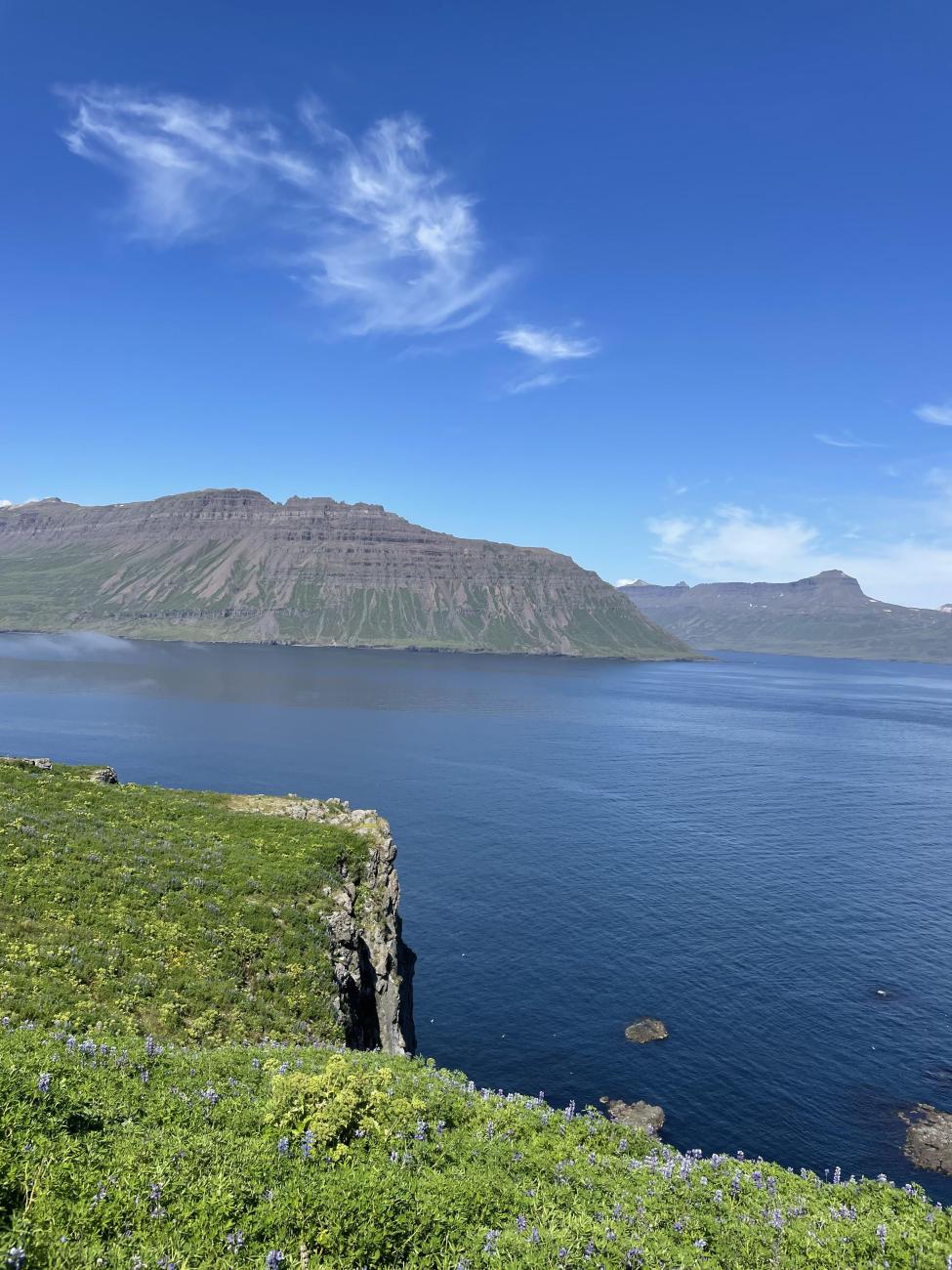
To complete this project, I spent some weeks on campus, learning about the method and preparing. I then joined a group of scientists working on paleomagnetism in Iceland. Iceland is ideal for this type of research due to the large amount of basaltic lava representing a large timescale. With this group I had the opportunity to learn about field procedures and see how post-doctoral scientists conduct field research. I collected several samples, both from ancient lavas and from more recent lavas. The method I will use to learn about the atmospheric pressure is not yet well accredited, so using newer lavas that solidified while under the current atmospheric pressure will help me determine if this method works or not.
To determine the average size of the vesicles I am using the CT scanner at the natural history museum in Oslo, I am still currently waiting on the results. However, this project has already provided me with an incredible opportunity to learn about field, lab and research procedures, as well as a great opportunity for networking as I have worked with researchers based in Japan, Iceland and Norway.