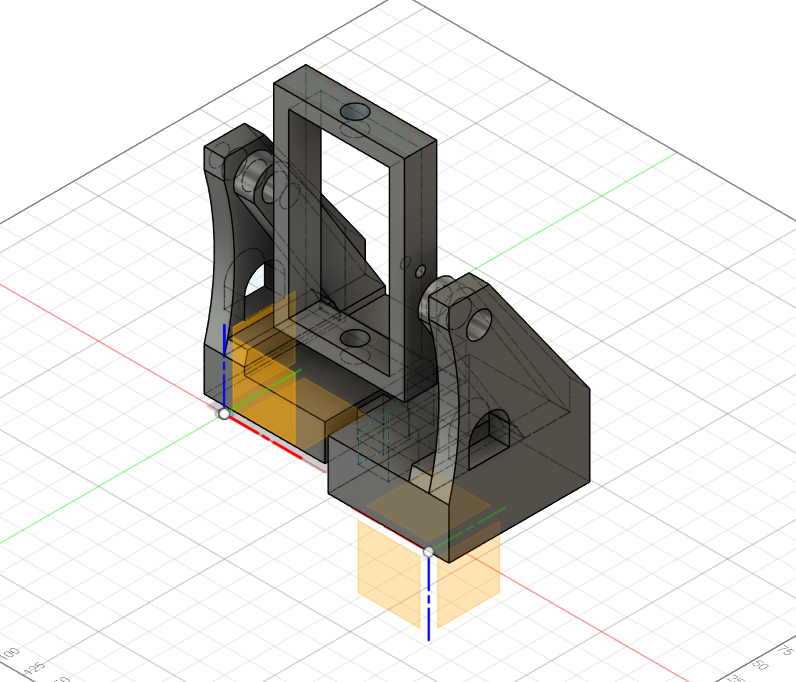


This summer research project explored the design and development of a 3D-printed clinostat, a rotating device used to mimic the effects of microgravity on biological samples. In microgravity, cells behave differently: they grow, divide, and organize in ways that aren't typically observed under Earth’s gravitational pull. Clinostats offer a way to simulate these conditions by constantly rotating cells, disrupting the unidirection of gravity and creating a near-weightless environment for experimentation.
The project began with mechanical design. Using Fusion 360, several versions of a clinostat were modeled with a focus on balance, compactness, and modularity. Because the 3D printer had a limited build volume, larger pieces had to be re-engineered into smaller interlocking parts that could be printed separately and assembled with precision. This introduced several challenges: ensuring parts fit together tightly, maintaining overall structural integrity, and minimizing wobble during rotation. Different printer settings and model were tested to optimize print quality and mechanical strength.
Once the physical structure was underway, the focus shifted to motion control and electronics. Using an Arduino, I programmed a series of rotational control systems testing both brushed and brushless motors. Electronic speed controllers (ESCs) regulated motor speed, while a built-in MPU-9250 sensor tracked movement and orientation in real time. However, sensor readings were initially unstable due to vibrations and electrical interference from the motors. This led to an in-depth exploration of signal processing: techniques such as Kalman filtering, Butterworth and notch filters, exponential moving averages (EMA), and fast Fourier transforms (FFT) were tested to clean up noisy data and improve accuracy.
Although the clinostat was not fully assembled by the end of the summer, the work completed laid a strong foundation. I developed skills in CAD modeling, embedded electronics, Arduino programming, 3D modeling and printing, and data filtering; each component an essential step toward a fully functioning microgravity simulator. This hands-on experience not only deepened technical knowledge but also highlighted the iterative nature of scientific prototyping and the importance of adaptability when designing complex systems from the ground up.