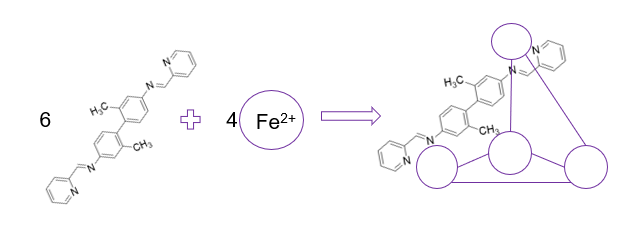


The research conducted for the Summer 2026 Fellowship focused on synthesizing an Iron(II) based discrete coordination cage with nitrogen-based organic ligands and evaluating its potential use in redox flow battery (RFB) technologies. Discrete coordination complexes (DCCs) are promising materials for next-generation energy storage because they may provide an alternative to the expensive vanadium-based electrolytes currently used in many RFBs. This project aimed to synthesize an Iron(II) based structure with electrochemical properties suitable for RFB applications.
Once the target cage was synthesized, cyclic voltammetry was used to investigate its electrochemical behavior and determine whether it exhibited reversible electron transfer. After observing promising characteristics of reversibility, I continued evaluating the complex under different experimental conditions and analyzing the resulting data.
Through this fellowship, I developed practical skills in chemical synthesis, electrochemistry, cyclic voltammetry, data analysis, and scientific communication. More importantly, I gained experience working independently through the research process, including troubleshooting experiments, interpreting unexpected results, and determining appropriate next steps. This experience allowed me to connect my chemistry and mathematics coursework to a real world challenge in sustainable energy and strengthened my interest in pursuing graduate research in materials science and engineering. I am grateful for the opportunity to contribute to research with potential applications in affordable, large scale renewable energy storage while growing as an independent researcher.