Active Research Project at the Space Lab
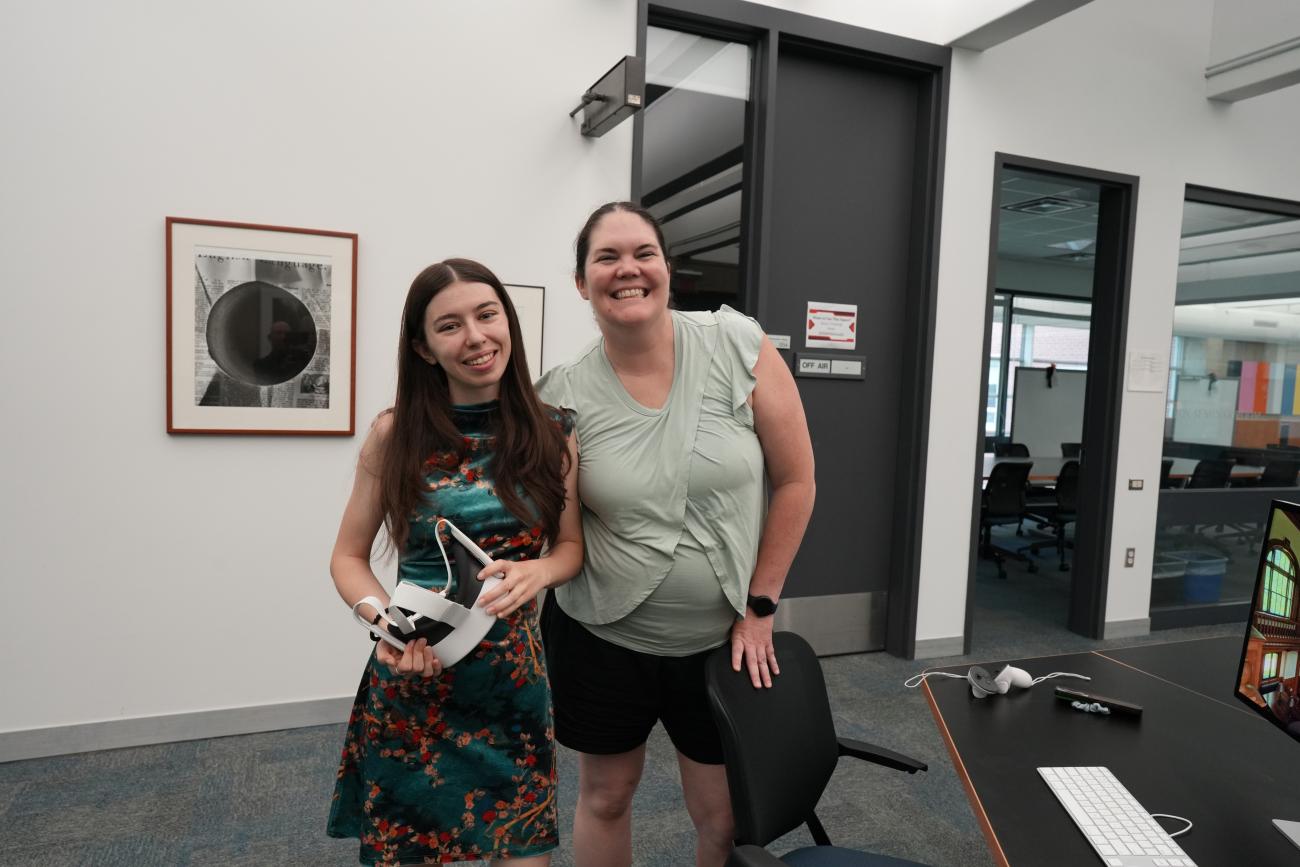
This was a well spend summer on campus as I had the opportunity to complete a research fellowship that explored how people experience different environments in virtual reality (VR) compared to real life. As part of this project, I learned to use Meta Quest VR goggles and created immersive VR environments using Kuula, a 360° rendering platform. Designing these virtual spaces gave me hands-on experience with VR technology and its potential for psychological and environmental research.
One of my main goals was to understand how people feel in a place when they see it through VR versus visiting it in person. To investigate this, we designed and ran a study using Qualtrics to collect participants’ ratings of various environments utilizing the Affective Quality of Place Questionnaire. I also gained valuable experience working directly with study participants, which strengthened my skills in research ethics, clear communication, and managing a structured research protocol.
After data collection, I dove into cleaning and analyzing the data using RStudio — a new skill set I was excited to build. Utilizing my previous knowledge from completing a Research Methods in Psychology class, now I learned how to calculate affective measures, create clear data visualizations, and run statistical tests to compare results across VR and real-life conditions.
We found that although participants generally rated real-life environments as slightly more pleasant than their VR counterparts, the difference wasn’t large enough to be statistically significant in this pilot study. This finding opened up great conversations about the growing realism of VR and its future use in research and design.
I am incredibly grateful to my mentor Dr. Elyssa Twedt, whose guidance and encouragement made this learning experience both supportive and challenging in the best way, as well as Eric Williams Bergen, for all of his technical and software support that made the environments come to life. Through this fellowship, I strengthened my skills in experimental design, VR technology, data analysis, and scientific communication — all of which I look forward to applying to future research projects at the Space Lab.