

This study investigates the glacial abrasion patterns at Nigardsbreen, a temperate outlet
glacier of the Jostedalsbreen Ice Cap, Southern Norway. The site is ideal for striation
analyses due to easy access and recent exposure due to continuous retreat. Current glacier
flowline models often assume spatially uniform basal conditions, which simplifies how ice
interacts with variable terrain and creates inaccurate predictions. This research provides a
spatial classification of glacier-bed interaction at Nigardsbreen, which reveals that directional
and geometric variability in striation clusters reflecting distinct zones of basal shear, erosion
and stable sliding. This offers a field-based framework to constrain subglacial processes in
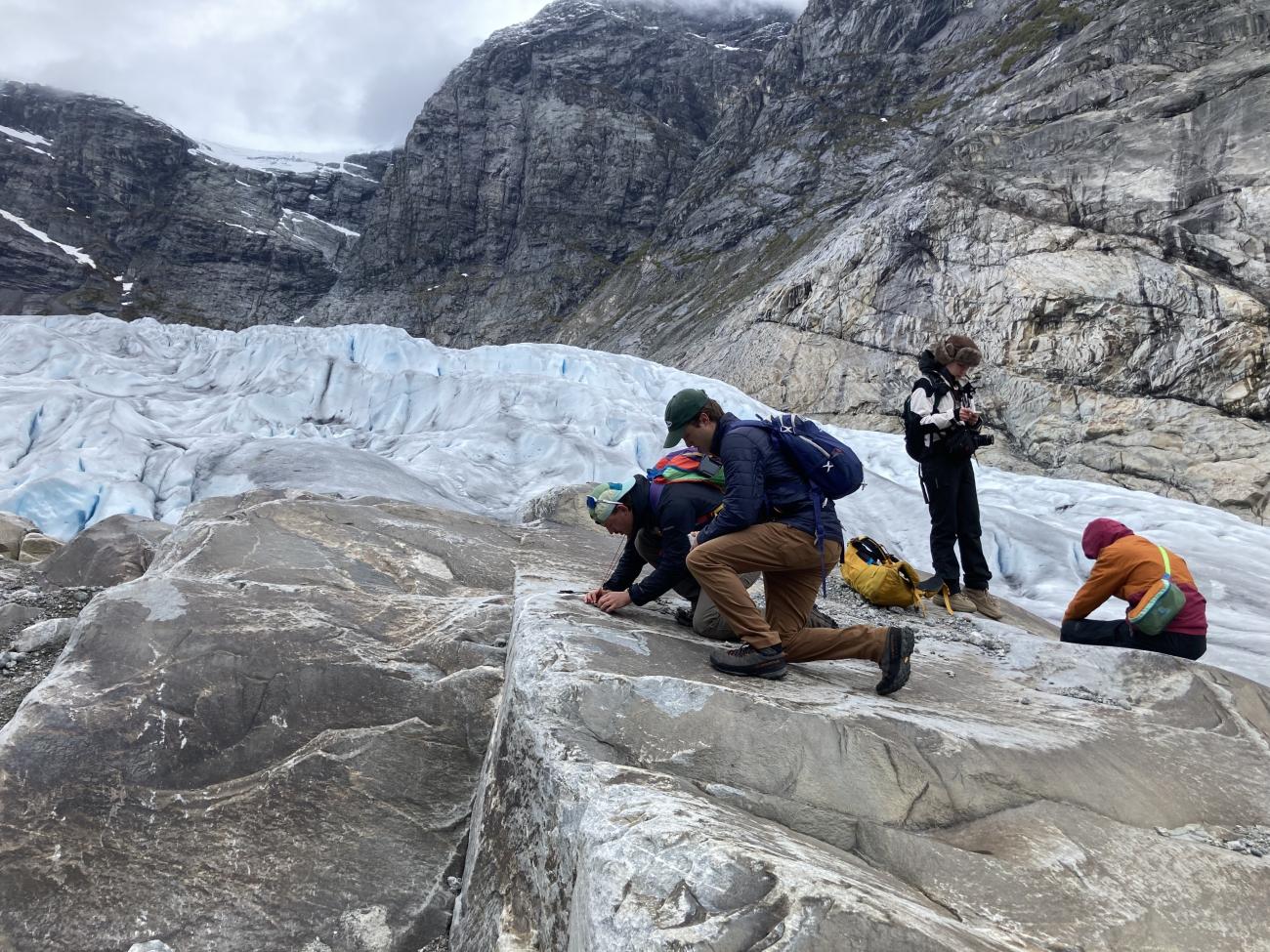
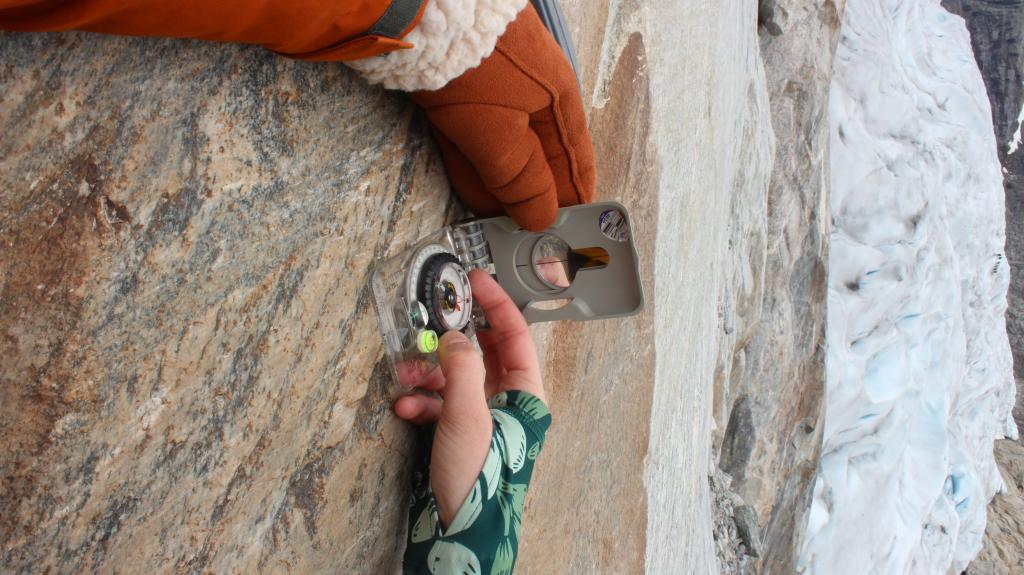
flowline models. Field data were collected using a geologic compass, measuring tape, digital
calipers, and later analysed using circular statistics, Python, ArcGIS, and Google Earth Pro.
We recorded over 430 striations (μ: 147.5°, 𝜎: 7.7°), 22 chattermarks (μ: 133°, 𝜎: 15.1), and
24 meso-scale bedrock lineaments found in mafic intruded granitic orthogneiss (μ: 139.9°, 𝜎:
61.2°). Rose diagrams generated in Python (using NumPy and Matplotlib) revealed a ~ 40%
orientation overlap between chattermarks and striations and < 5% overlap between mesoscale
bedrock features and chattermarks as well as between the meso-scale bedrock features
and striations.
To assess if the three directional populations where statistically distinct, the Mardia-Watson-
Wheeler test for homogeneity was applied. The results showed significant differences
between groups (p < .0001) which confirmed their independence despite the superficial
similarities.
Interpretations suggest that striation azimuths more closely represent primary ice flow
direction,to the southeast parallel to the km-scale valley, while chattermarks may record
episodic shifts and basal shear. Directional analysis of striations is a low-cost, high-resolution
tool that supports the classification of distinct glacier-bed regimes and demonstrates how
directional morphometrics can be used to identify zones of streamlined sliding, stress
accumulation and erosion, which provides field-based constraints for spatially variable basal
drag in flowline models.