Japanese Knotweed Management

Over the summer of 2025, AJ DiFranco interned at Briar Bush Nature Center in Abington, Pennsylvania. Having worked as an environmental education volunteer at nature centers in the past, he set a goal to learn a few new practical, hands-on conservation skills that would directly benefit him as he entered the field of wildlife conservation. The financial award from SLU allowed him to comfortably accept a valuable unpaid position at Briar Bush and still focus entirely on his college education.
As a natural lands management intern, AJ assumed many responsibilities at Briar Bush; his first major project in early summer was tree planting, where he dug, planted, watered, and deer-proofed roughly 50 tree saplings. He also learned conservation planting techniques, such as spacing, watering, and planting depth, while working on that project. AJ also learned how to remove invasive and overgrown plants, as well as felled trees. To do so, he was taught how to effectively use many different tools such as loppers, pruners, limb saws, hand saws, uprooters, pickaxes, and more. He also learned how to identify and properly remove "dangerous" plants like poison ivy and stinging nettle, as well as invasive plants like Oriental Bittersweet, Japanese Barberry, Porcelain Berry, Multiflora Rose, English Ivy, and Garlic Mustard. One plant he spent a particularly large amount of time on was Chinese Wisteria, in which he heavily cut back a stand of Chinese Wisteria that had been encroaching on the newly built butterfly house at Briar Bush.
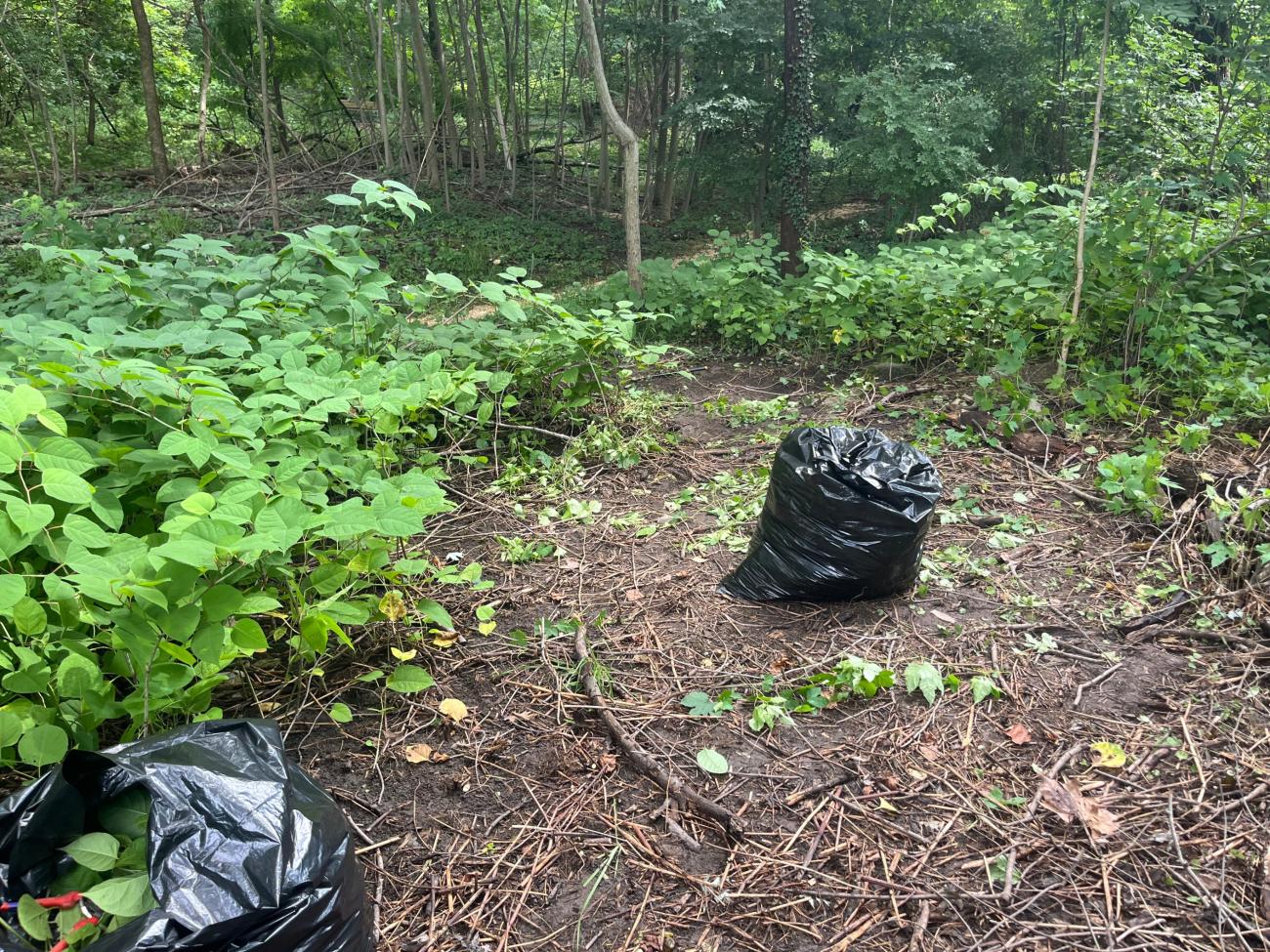
However, AJ's most significant project at Briar Bush was his Japanese Knotweed management project. He was tasked by his supervisor to find a way to remove an established stand of Japanese Knotweed on Briar Bush's property and develop a long-term plan to manage and eventually eradicate the plant over several years. Without access to specialized herbicides that could kill such a persistent plant as Knotweed, AJ applied his knowledge of plant ecology and physical species control to develop and execute a plan to manage the knotweed. He first cut down the knotweed that had already grown, then laid down a combination of mulch and weed tarp to both stop the knotweed from receiving sunlight and prevent it from growing through either the mulch or puncturing the tarp with its stalks. He was also able to dynamically apply the knowledge he learned during the project to his management plan; for example, he had originally planned on bagging the knotweed clippings to prevent them from spreading and sprouting elsewhere in the park, he found that if left on the ground instead, the sunlight both dried out and killed the knotweed clippings AND helped prevent some new growth. Additionally, he also had to learn to adapt to various challenges that arose, such as animals ripping holes in the tarp and adverse weather/flooding ruining the mulching; a necessary skill in the field of conservation biology where such things happen all of the time. Lastly, before the end of his time at Briar Bush, he drafted a long-term knotweed removal plan to instruct future interns and volunteers, share management tips, and identify areas the knotweed could potentially spread. With luck, Briar Bush will be completely knotweed-free in about five years if the plan is stuck to.
Overall, AJ greatly appreciated the hands-on experience he gained at Briar Bush. He enjoyed learning more about the local forest ecology in which he grew up, and how to manage invasive species to better protect those forest ecosystems. For the future, AJ wishes to apply the skills he learned at Briar Bush to contribute to other wildlife conservation projects in new, different environments, and is excited to begin searching for summer wildlife conservation opportunities for 2026.